
Phiquest POV
AI adoption is not a tooling problem. It is an operating model problem.
Humans working with AI can make the world better, but that future will not happen by accident. Organizations need governed, measurable systems of work where humans and AI agents build together.
Public manifesto
The future is humans and AI agents building together.
Humans working with AI can make the world better.
But that future will not happen by accident.
Right now, too many organizations are chasing AI because of pressure, not purpose. Teams are experimenting with powerful tools, but without clear ownership, governance, measurement, or a path to real business value.
We reject the idea that AI adoption is just a tooling problem.
We reject hype without execution.
We reject automation that blindly replaces people instead of redesigning how work gets done.
We reject pilots that create excitement but never become operating capability.
Phiquest exists to help teams move from scattered AI experimentation to governed, measurable business value.
We help organizations redesign systems of work, build AI-augmented teams, create governed speed, and move from pilots to production.
The future is not humans versus AI.
The future is humans and AI agents building together.
What Phiquest rejects
Phiquest is not here to sell AI hype.
Prompt tips pretending to be transformation
Pilots that never become capability
Blind automation instead of redesigning work
Human-in-the-loop theater
AI activity metrics without system improvement
The point is not to use more AI. The point is to design better systems of work.
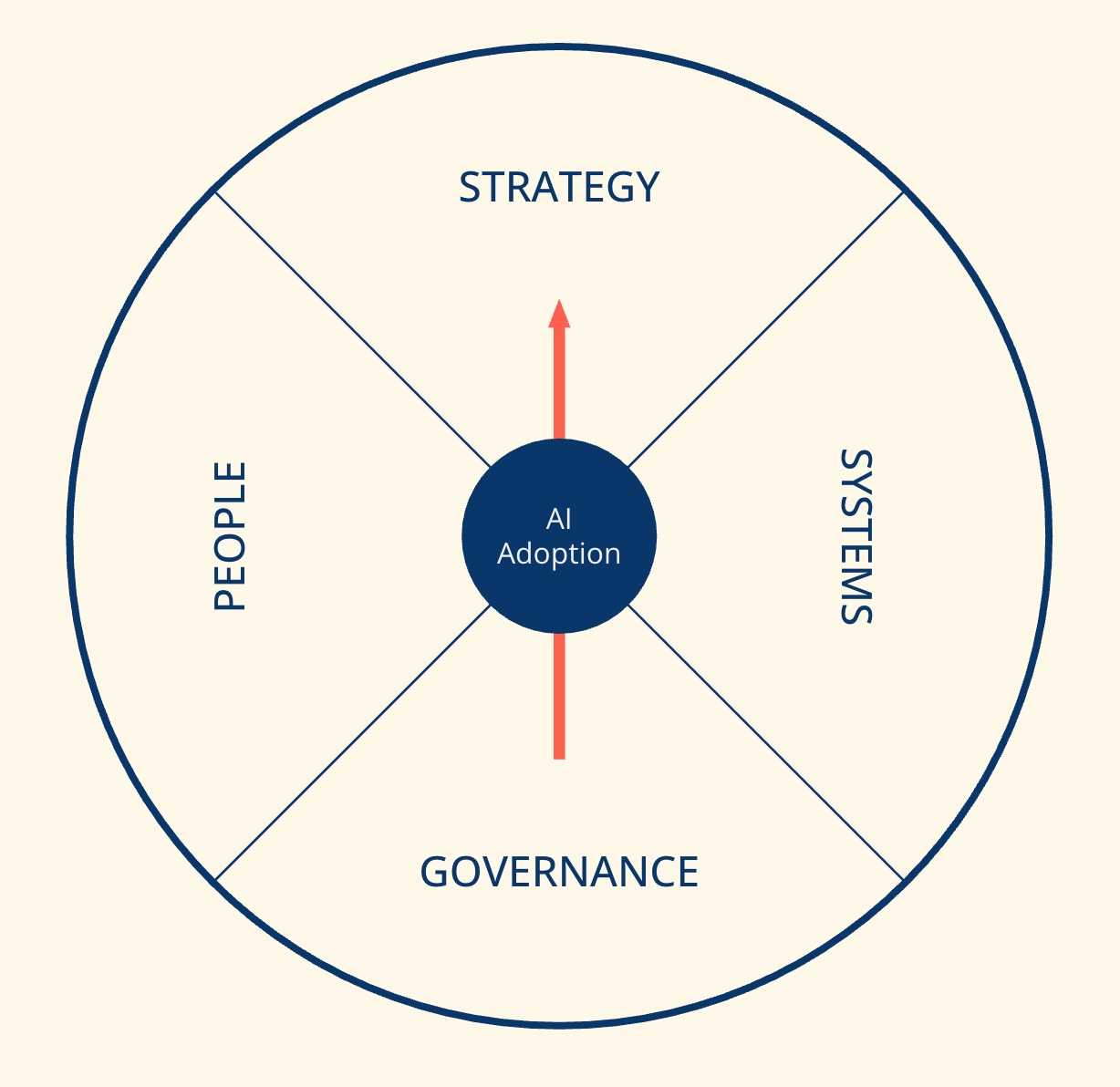
AI Adoption Compass
The AI Adoption Compass
Assess readiness across Strategy, People, Systems, and Governance before scaling. Strong tools cannot overcome unclear strategy, weak workflow design, or missing guardrails.
Strategy
Question: What business outcomes should AI improve?
Failure sign: Lots of experiments, few measurable outcomes.
People
Question: How will humans and teams change how they work?
Failure sign: Unclear ownership and inconsistent review.
Systems
Question: How will AI integrate into workflows, tools, and data?
Failure sign: AI tools sit outside delivery systems.
Governance
Question: What guardrails, review standards, and accountability models are needed?
Failure sign: No clear approval, escalation, audit, or risk model.
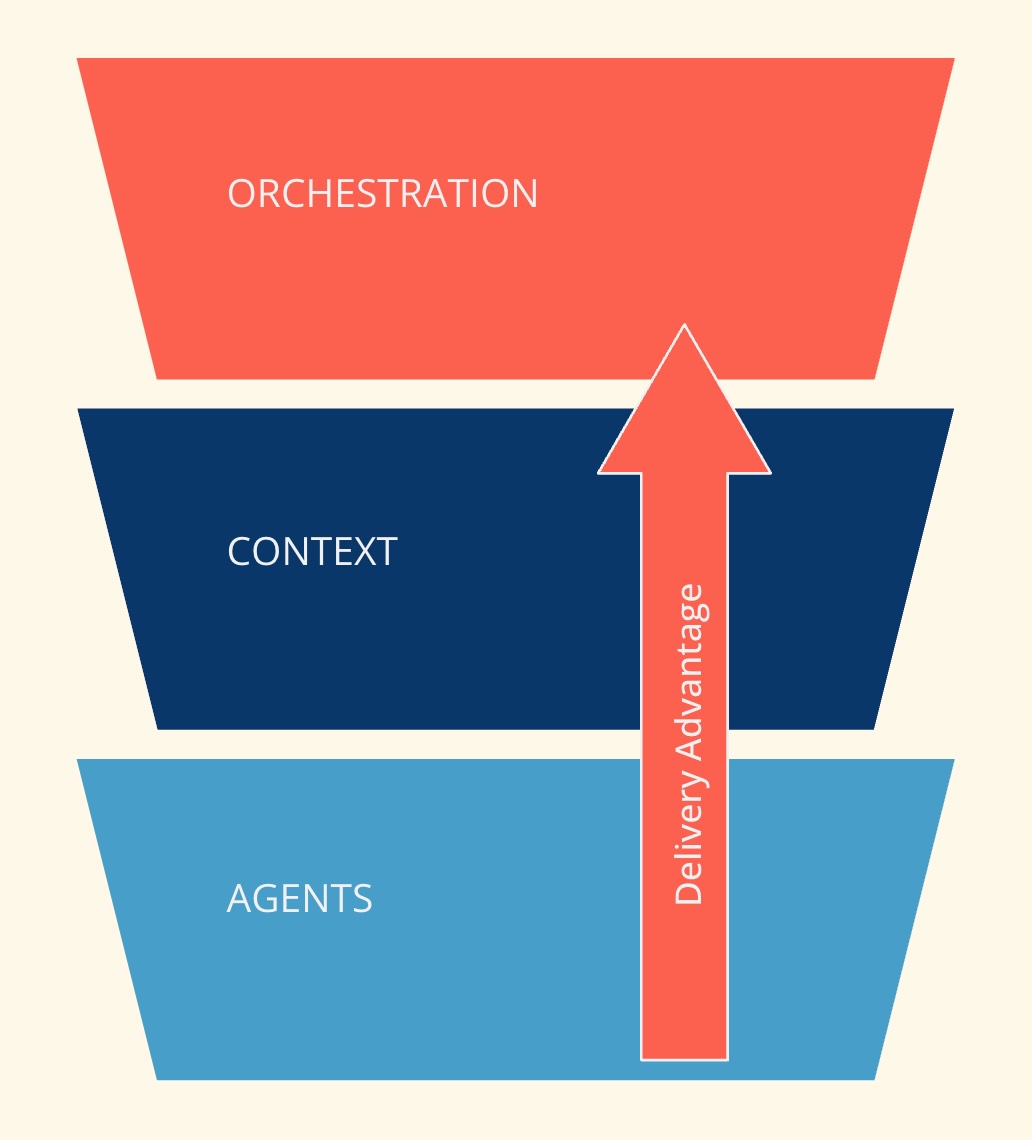
The AI Advantage Stack
As AI agents become easier to access, orchestration becomes the differentiator.
AI agents are moving toward commodity inputs as access broadens and capabilities converge. The durable advantage will not come from tool access alone. It will come from proprietary context and the ability to orchestrate humans, agents, workflows, governance, and metrics into repeatable value creation.
Agents
AI models and agents that write, code, summarize, analyze, research, test, monitor, and automate.
Context
Proprietary data, domain knowledge, workflows, architecture, constraints, customer insight, and operating standards.
Orchestration
The operating model that combines humans, agents, context, governance, review, and metrics into reliable systems of work.
The future advantage is not AI access. It is the ability to assemble and operate human-AI systems better than competitors.
Human-in-the-loop is not enough.
AI-assisted work needs Auditable Delegation.
When AI contributes to decisions, recommendations, analysis, code, documentation, or operational workflows, the accountable human needs more than a chance to approve the output. They need enough context to understand, review, challenge, accept, or escalate the work.
- AI Output
- Human Review
- Risk Acceptance
- Approval / Escalation
- Audit Trail
Understandable
Humans can see what the AI produced and why it matters.
Reviewable
Humans have clear standards for evaluating the output.
Reconstructable
The decision path can be traced after the fact.
Accountable
A person or team owns the final outcome.
Escalatable
Uncertainty, risk, or low-confidence outputs have a defined path.
If humans remain accountable for outcomes, AI-assisted work must be auditable by the people responsible for the result.
Pilot-to-production pathway
Pilots should produce evidence, not excitement.
A good AI pilot is designed to produce a decision: scale, revise, stop, or invest further.
| Step | Stage | Purpose |
|---|---|---|
| 1 | Explore | Identify candidate use cases |
| 2 | Select | Choose a high-value, feasible, governable pilot |
| 3 | Design | Define workflow, roles, guardrails, data, and metrics |
| 4 | Test | Run a controlled pilot with real users |
| 5 | Measure | Evaluate value, quality, adoption, risk, cost, and operational fit |
| 6 | Operationalize | Integrate into the workflow and assign ownership |
| 7 | Scale | Expand proven patterns to adjacent workflows or teams |
Cost-to-outcome
Measure cost-to-outcome, not AI activity.
The goal of AI adoption is not more prompts, more tools, or more agent activity. The goal is a better operating result.
Phiquest evaluates whether a human-AI workflow produces the desired outcome with less time, less cost, less rework, less risk, and less operational friction.
AI usage is not the metric. Improvement in the system of work is the metric.
- Time to first working pilot
- Human review effort per output
- Rework rate
- Quality threshold pass rate
- Workflow cycle time improvement
- Pilot-to-production conversion rate
- Decision audit completeness
- Adoption rate by role or team
Signature Phiquest concepts
A shared language for governed AI adoption.
AI Adoption Operating Model
How an organization turns AI capability into measurable business value through strategy, people, systems, governance, workflows, metrics, and learning.
AI Adoption Compass
A practical framework for assessing readiness across Strategy, People, Systems, and Governance.
System-of-Work Redesign
Redesigning how work is discovered, planned, produced, reviewed, governed, measured, and improved with AI.
Governed Speed
Moving quickly with AI while protecting quality, security, privacy, accountability, and trust.
Auditable Delegation
Making AI-assisted work understandable, reviewable, reconstructable, and acceptable to accountable humans.
Human-AI Team Orchestration
Assembling, directing, governing, measuring, and improving teams made up of humans, AI agents, workflows, tools, and review mechanisms.
Cost-to-Outcome
Measuring how efficiently the human-AI system converts effort, data, tools, and governance into measurable business results.
Want to apply these concepts with your team? Request the AI Adoption Worksheet Pack.
Request the Worksheet PackReady to turn the POV into action?
Ready to turn the POV into action?
Start with the AI Adoption Strategy Guide. When your team is ready to apply the framework, request the worksheet pack or schedule a readiness conversation.